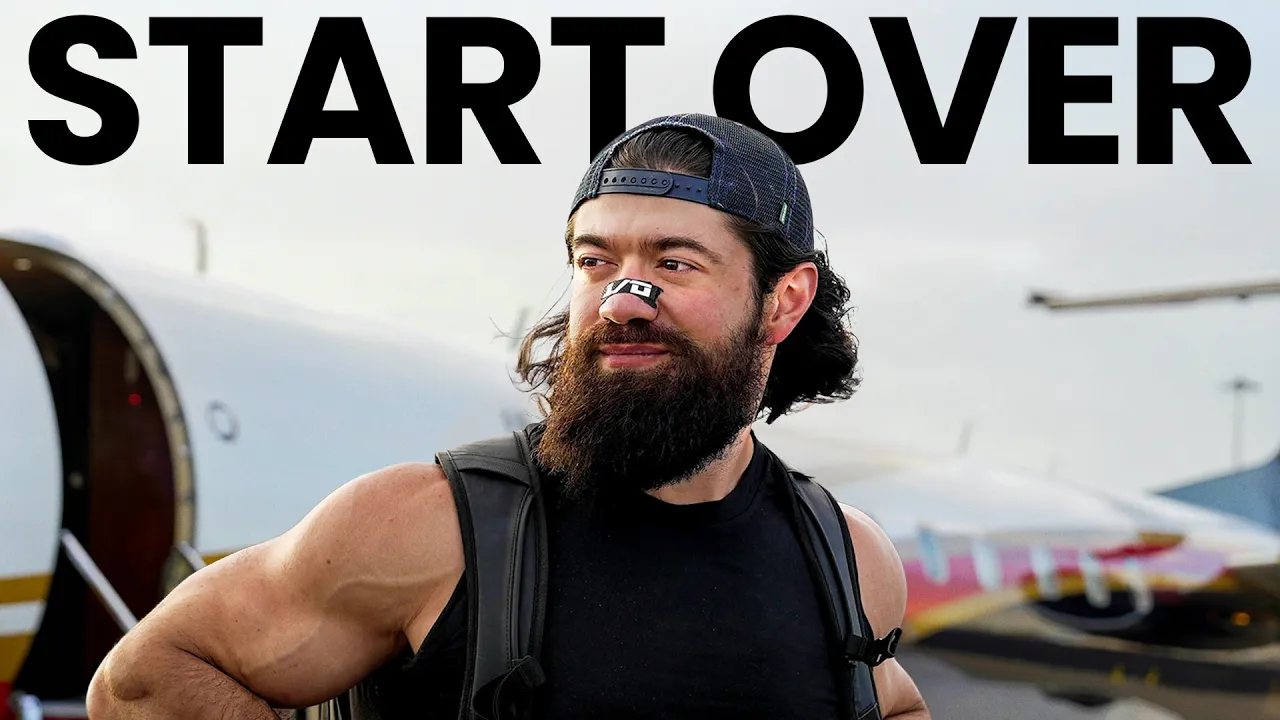
The mindset that is slowly destroying your life...
Summary
The 'prison of certainty' mindset, rooted in the schooling system's 'one-shot brain' approach, inhibits individuals from pursuing dreams by demanding 100% assurance of success before action. Real-world success, however, operates on an 'infinite-shot game' model, where continuous experimentation and learning from failures are crucial for progress. Overcoming this mindset involves adopting an experimental approach, making decisions with imperfect information, and recognizing the 'two-way door' nature of most life choices to achieve personal and financial goals.
Key Takeaways
- 1The 'prison of certainty' is the belief that progress is impossible without absolute assurance of success.
- 2The schooling system fosters a 'one-shot brain' mentality where preparation for single, high-stakes attempts is prioritized.
- 3Real-world success, particularly in business and personal goals, is an 'infinite-shot game' where numerous attempts lead to eventual success.
- 4Operating in 'defend mode', often conditioned by school and social pressures, prioritizes security and avoids risk, hindering discovery and growth.
- 5Most decisions, especially in personal or entrepreneurial pursuits, are 'two-way doors', meaning they are easily reversible with minimal cost.
- 6Overthinking imposes an 'overthinking tax', wasting time, losing potential earnings, and causing anxiety.
- 7Adopting an experimental mindset, framing actions as tests, and focusing on gathering data rather than perfection, significantly boosts progress.
The Prison of Certainty: A Detrimental Mindset
The 'prison of certainty' describes an invisible mental confinement where individuals hesitate to act unless absolutely sure of success. This belief, while seemingly rational for avoiding wasted effort, often leads to stagnation, especially when pursuing significant dreams like financial independence or starting a business. This psychological barrier prevents many from taking initial steps, leading to extended periods of planning and analysis without concrete action. This phenomenon is exacerbated in situations where current conditions are 'just okay,' a concept known as the region beta paradox, making it harder to initiate change than in truly dire circumstances.
Origins of Overthinking: The One-Shot Brain
The schooling system significantly contributes to the 'prison of certainty' by fostering a 'one-shot brain' mentality. Educational structures, characterized by finite curricula, high-stakes exams, and limited university application attempts, train individuals to prepare extensively for a single, critical opportunity. This conditioning prioritizes meticulous planning and perfection to maximize a singular chance of success. While effective for academic achievement, this rigid approach is counterproductive for most real-world endeavors, which rarely offer guarantees.
Defend Mode vs. Discover Mode
Psychologists identify 'defend mode' and 'discover mode' as contrasting states of mind. Children naturally operate in discover mode, characterized by curiosity, playfulness, openness to new experiences, and a willingness to fail. Conversely, defend mode, often cultivated through schooling's emphasis on pass/fail and social pressures, involves constant threat scanning, optimizing for security, and fear of looking foolish or losing what has been gained. This shift from intrinsic growth to defensive behavior inhibits risk-taking and experimentation essential for real-world achievement outside structured environments.
Real-World Success: The Infinite Shot Game
Most adult life pursuits, including business and personal dreams, function as 'infinite-shot games' rather than one-shot endeavors. Unlike baseball, where points are capped, the real world often allows unlimited attempts with uncapped potential rewards. Success might require numerous trials, with only one needing to yield significant results. This principle suggests that taking more shots, even imperfect ones, dramatically increases the likelihood of a major breakthrough. Overthinking and excessive preparation for a single, perfect attempt become detrimental when the path to success involves continuous iteration.
Two-Way Doors and the Overthinking Tax
Decisions can be classified as 'one-way doors' (irreversible without massive cost, e.g., marriage or having children) or 'two-way doors' (easily reversible). Most pursuits, like starting a business or posting online content, are two-way doors, making extensive overthinking unnecessary. The 'overthinking tax' manifests in three ways: wasted time, lost potential earnings (due to delayed action), and heightened anxiety, as operating in defend mode is inherently unpleasant. Reducing overthinking on reversible decisions liberates time, accelerates learning, and improves overall well-being.
Adopting an Experimental Mindset
Overcoming the prison of certainty requires recognizing one's overthinking patterns and adopting an experimental mindset. This involves assessing the necessary level of certainty for a decision, aiming for a lower threshold (e.g., 20% confidence) for action. Framing actions as 'experiments' is a powerful hack that reframes potential failures as valuable learning experiences, providing useful data regardless of the outcome. This approach encourages quicker iterations of problem identification, hypothesis generation, cheap experimentation, and data review. Stanford business school professors Bill Burnett and Dave Evans advocate 'wayfinding,' a process of continuous experimentation and data gathering to discover one's life path, contrasting it with prolonged internal deliberation.
FAQ
What is the main insight from The mindset that is slowly destroying your life?
The 'prison of certainty' mindset, rooted in the schooling system's 'one-shot brain' approach, inhibits individuals from pursuing dreams by demanding 100% assurance of success before action. Real-world success, however, operates on an 'infinite-shot game' model, where continuous experimentation and learning from failures are crucial for progress. Overcoming this mindset involves adopting an experimental approach, making decisions with imperfect information, and recognizing the 'two-way door' nature of most life choices to achieve personal and financial goals. One important signal is: The 'prison of certainty' is the belief that progress is impossible without absolute assurance of success.
Which concrete step should be tested first?
The 'prison of certainty' is the belief that progress is impossible without absolute assurance of success. Define one measurable success metric before scaling.
What implementation mistake should be avoided?
Avoid skipping assumptions and execution details. The schooling system fosters a 'one-shot brain' mentality where preparation for single, high-stakes attempts is prioritized. Use this as an evidence check before expanding.
Related Summaries

How to change your life by journaling in 2026

BOUNDARIES by Henry Cloud and John Townsend Audiobook | Book Summary in English
The Only 12 Minutes You Need To Master Self-Control & Purpose | Robert Greene Motivation

The Most Valuable 8 Minutes You’ll Hear Today | Jocko Willink Motivation

8 Small Habits From The Bible That Changed My Life

7 Things Every Man Should Master before 30 | The Bedros Keuilian Show E0178

Fix Your Life - One Step at a Time || Graded Reader || Improve Your English Fluency ✅️
10 Rules for Success in Life || Learn English With Motivation || Improve Your English ✅️
Life is Short - It's Time to Wake up || Graded Reader || Improve Your English ✅️

How to Talk to Anyone Without Freezing || Graded Reader || Speak English Confidently and Fluently ✅️

The Power of Self-Control - Master Self-Control || Improve Your English Fluency ✅️

GRWM while I finally spill everything… where i’ve been, healing, & the truth

How to Stay Confident in Difficult Conversations | LIVE with Kwame Christian

528 Hz 🎧 BILLIONAIRE ”I AM" Affirmations For Wealth, Health, Prosperity & Happiness 2026

Tom Brady’s Advice Will Leave You SPEECHLESS (MUST WATCH)

8 Tiny Habits That Made Me Rich

How To Think Like A Strategic Genius (5-Dimensional Thinking)

When Everything Is Falling Apart, Do THIS | The Bedros Keuilian Show E0177

The #1 Health Upgrade Nobody Talks About (It’s NOT Diet or Training)